Solutions by role
Insurance operations software: underwriting, servicing and claims workflow
Insurance operations software organises the daily work of an insurer into queues and workflows: new applications waiting for underwriting, policy changes to process, premiums to allocate, claims to assess and approve, and documents to file. Its job is to make sure each item reaches the right person, is completed with the right information, and leaves an audit trail.
Ontech LifeI ERP gives operations teams at life insurers in Zambia underwriting and claims workflows, automated rules for standard cases, policy servicing tools, document management and bulk operations, so the team handles more volume without adding manual steps.
Key capabilities
Underwriting workbench
Applications arrive in a queue with the medical declaration, documents and quotation attached; standard risks are accepted by rule and the rest are referred with a reason.
Policy servicing
Endorsements, beneficiary changes, frequency changes, reinstatements, surrenders, paid-up conversions and policy loans processed against the policy with effective dates.
Claims workflow
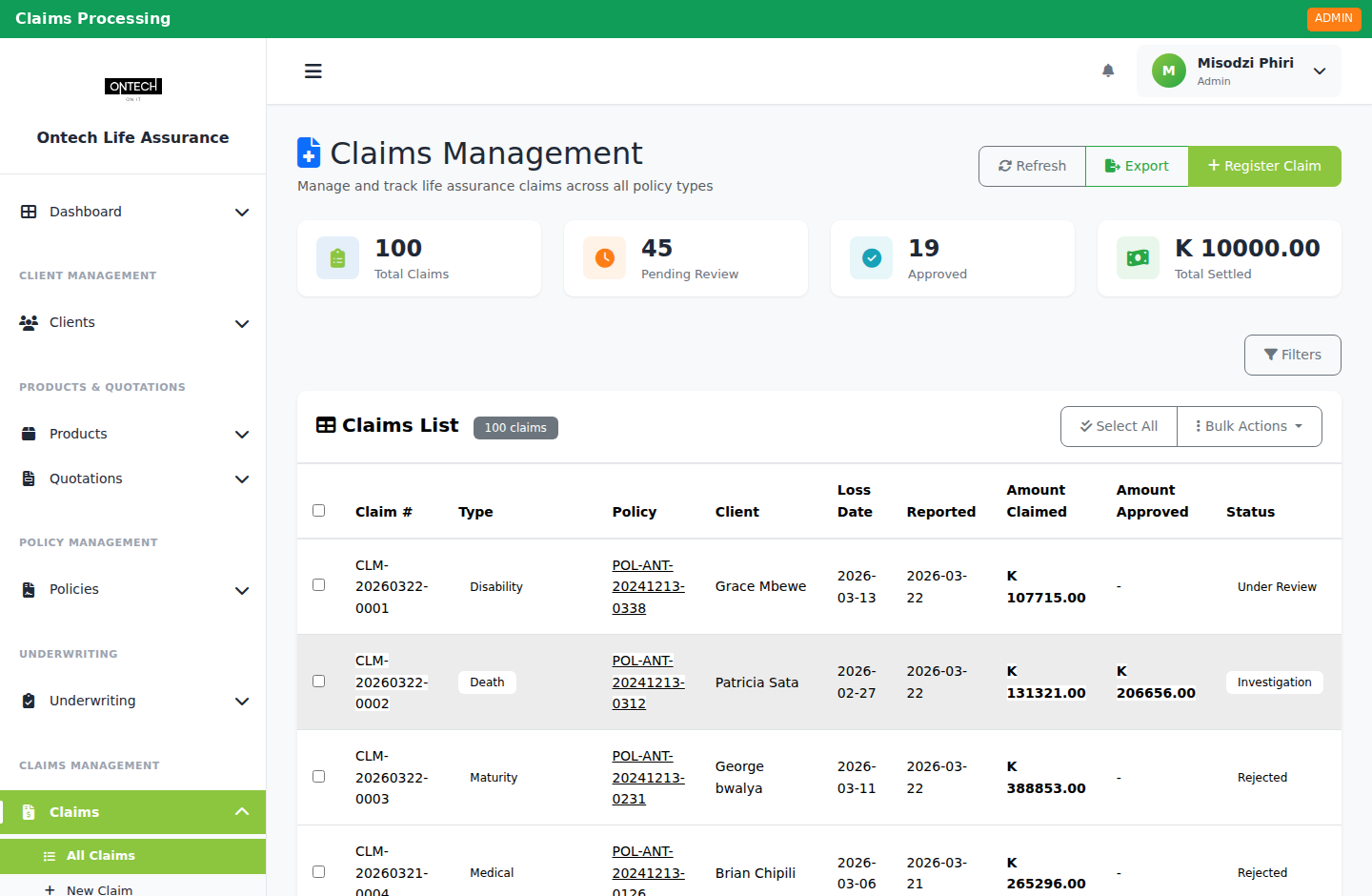
Claims are registered, triaged, assigned, documented and moved through review and multi-level approval to settlement, with SMS updates to the claimant.
Automation and business rules
Renewal reminders, lapse processing, scheduled reports and notification templates run on schedule without manual triggering.
Document management
Identity documents, medical reports, death certificates and correspondence are stored against the client, policy or claim and retrievable from any screen.
Bulk operations
Import clients, policies or group members from spreadsheets and export data for audits or migration.
Support tickets and call centre
Customer queries by phone, portal or WhatsApp are logged as tickets linked to the policy and tracked to resolution.
How it works
- Work items are created automatically: an application from any channel enters underwriting, a claim from the portal enters the claims queue.
- Rules handle routine cases, such as accepting clean applications within limits or lapsing policies after the grace period.
- Everything else is assigned to a person with the information attached and a due date.
- Approvals move through the levels the insurer has defined, with maker-checker separation on payments.
- Policyholders receive SMS or WhatsApp updates at each stage, reducing inbound calls.
- Every action is logged with who, what and when for supervision and audit.
Benefits
Less searching, more processing
The documents and history a case needs are on the case, not in a filing cabinet or someone's inbox.
Consistent decisions
Rules apply the same limits and referrals to every application and claim, whichever office handles it.
Visible workloads
Supervisors see queues, ageing and who holds what, and can rebalance before backlogs build.
Fewer customer calls
Automatic status updates by SMS and WhatsApp answer the most common question before it is asked.
Who it is for
- Heads of operations, underwriting managers and claims managers at life insurers in Zambia.
- Teams moving from paper files and email approvals to a workflow system.
- Insurers whose new-business or claims volumes are growing faster than headcount.
Zambia-specific considerations
Applications and claims in Zambia often arrive with photographed documents from a phone, through an agent in the field or a policyholder using the app. Operations software has to accept documents in that form, verify them and keep them with the case, rather than assuming paper originals.
The Pensions and Insurance Authority expects licensed insurers to handle claims fairly and promptly and to keep records that can be inspected. A workflow with timestamps, assigned owners and an audit trail gives operations managers evidence of how each case was handled.
How Ontech LifeI ERP addresses this
AI-assisted triage and auto-underwriting
Ontech LifeI ERP can triage incoming claims by type and completeness and accept standard applications automatically, leaving people to work on the cases that need judgement.
Workflow, approvals and audit built in
Multi-level approvals, maker-checker on payments, notification templates and a complete audit log are standard rather than add-ons.
Servicing from every channel
Requests from the client portal, Android app, USSD, WhatsApp, agents and the call centre all land in the same queues with the same policy record behind them.
Frequently asked questions
What is insurance operations software?
It is the part of an insurance system that manages daily work: underwriting queues, policy servicing, claims workflow, document handling, automation and approvals, with an audit trail of every action.
How does automated claims processing work?
Incoming claims are triaged by type and completeness, routed to the right handler, and moved through review and approval levels. Routine steps such as acknowledgements and status updates are sent automatically, while decisions remain with people.
Can customers submit claims and documents digitally?
Yes. Policyholders can submit claims with photographed documents through the client portal or Android app, and agents can do so on their behalf. The documents attach to the claim.
Does Ontech LifeI ERP support multi-level approvals?
Yes. Approval levels are configured per process, and payments use maker-checker separation so the person preparing a payout cannot approve it.
Can we import existing policies and clients?
Yes. The bulk operations module imports clients, policies and group members from spreadsheet files and exports data for audit or migration.
See Ontech LifeI ERP for your company
Book a demo with Ontech Solutions in Lusaka and see policy administration, claims, Mobile Money collection and PIA reporting working together in one platform.
Last updated 2026-09-13. Published by Ontech Solutions, Lusaka, Zambia.