Platform
Insurance compliance and regulatory reporting software
Insurance compliance software helps an insurer meet its obligations to the regulator, the tax authority and its auditors by producing regulatory returns from operational data, keeping an audit trail of every transaction and decision, controlling who can access and change records, and tracking the obligations and deadlines the company must meet. It does not replace the compliance function; it gives it reliable data and evidence.
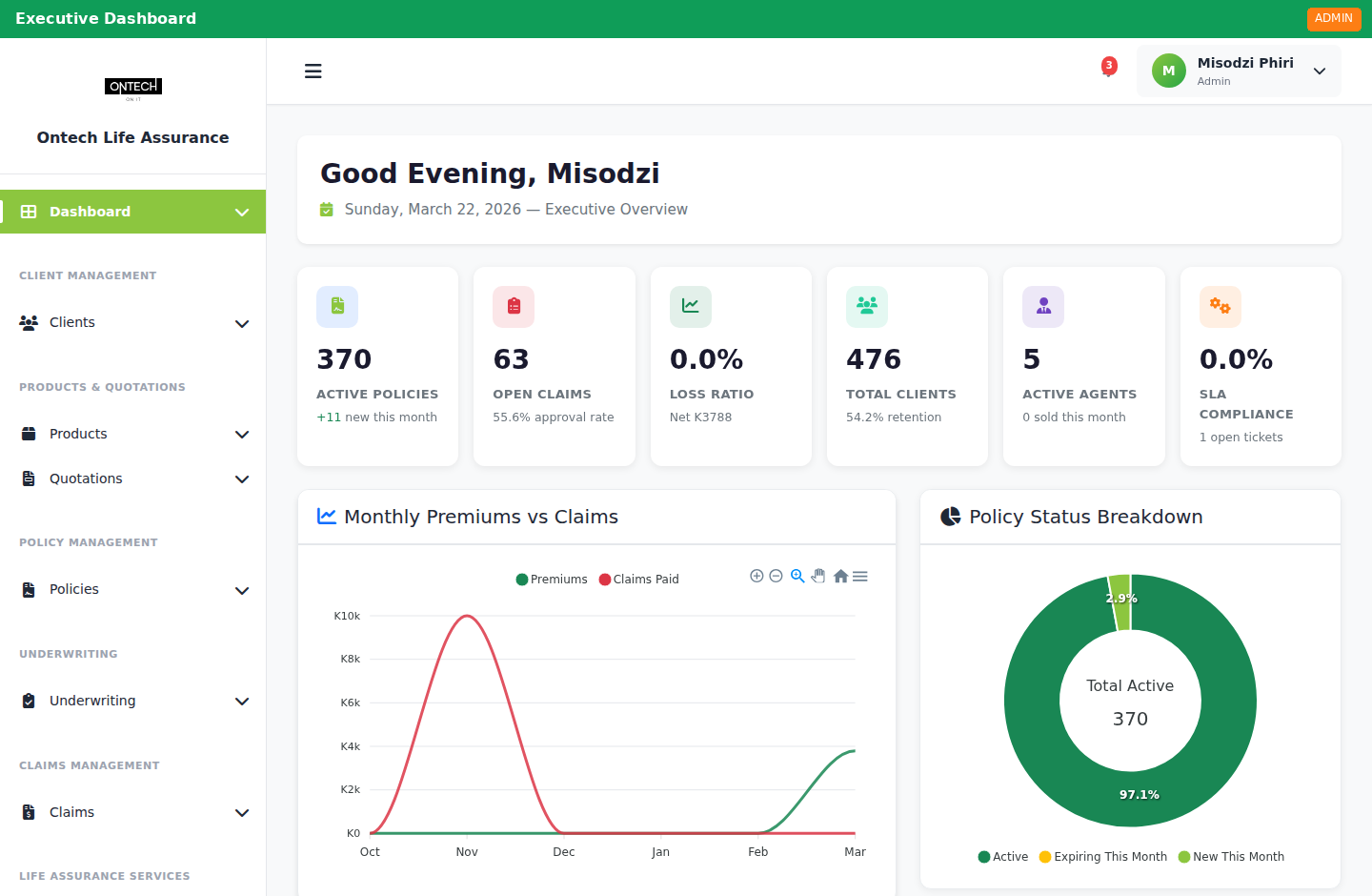
Ontech LifeI ERP includes compliance tracking, PIA-oriented life insurance reports, an audit trail, role-based access and maker-checker controls, all drawn from the same policy, claims and finance records used to run the business.
Key capabilities
Regulatory reports
Produce production, claims, persistency and financial reports in the structure needed for periodic statutory returns to the Pensions and Insurance Authority.
Compliance tracking
Record the company's obligations under the Insurance Act and related laws, assign owners and due dates, and track evidence of completion.
Audit trail
Log who created, changed or approved every policy, claim, payment and user record, with timestamps.
Access control and MFA
Restrict data and functions by role and require multi-factor authentication for administrative logins.
Maker-checker approvals
Require separate preparation and approval of claim settlements, payouts and commission runs.
Tax and statutory payroll
Support PAYE, NAPSA and NHIMA deductions in payroll and tax reporting to the Zambia Revenue Authority.
Data protection controls
Limit access to personal and health data and keep consent records to support obligations under the Data Protection Act.
How it works
- Obligations, reporting deadlines and owners are set up in the compliance register.
- Day-to-day transactions in policies, claims, collections and finance are logged automatically to the audit trail.
- Report templates draw production, claims, persistency and financial figures from the live registers at period end.
- Compliance staff review the reports, attach evidence and mark obligations as met.
- Auditors and inspectors are given read-only access or exports of the records they ask for.
Benefits
Returns from real data
Figures in statutory returns reconcile to the policy register and the ledger because they come from the same place.
Evidence on demand
The audit trail answers who did what and when without reconstructing events from email.
Fewer control failures
Role-based access and maker-checker approvals enforce segregation of duties in the system rather than by policy document.
Deadlines visible
Obligations and due dates sit in one register instead of in individual staff members' calendars.
Who it is for
- Compliance officers and company secretaries at licensed insurers in Zambia.
- Finance teams preparing statutory returns and audited financial statements.
- Internal audit and risk functions that need transaction-level evidence.
- Boards that want assurance that controls are enforced in the systems staff use.
Zambia-specific considerations
The Pensions and Insurance Authority (PIA) licenses and supervises insurers in Zambia under the Insurance Act No. 38 of 2021 and requires periodic statutory returns and financial statements. Insurers also report to the Zambia Revenue Authority, contribute to NAPSA and NHIMA for staff, and process personal data under the Data Protection Act No. 3 of 2021.
Because these obligations draw on the same underlying records, a platform that keeps policies, claims, finance and HR together makes it easier to produce consistent submissions and to show inspectors the evidence behind them.
How Ontech LifeI ERP addresses this
Reports shaped for statutory returns
Life reports cover production, claims, persistency and financial figures, and compliance tracking records obligations under the Insurance Act and related laws.
Controls enforced in the system
Role-based access across user roles, email multi-factor authentication for administrators and maker-checker approvals on payouts.
A single audit trail
Every policy, claim, payment, user and configuration change is logged and can be exported for auditors or the regulator.
Frequently asked questions
What is PIA compliance?
PIA compliance means meeting the requirements set by the Pensions and Insurance Authority, the regulator of insurance and pensions in Zambia. For an insurer this includes holding a valid licence, keeping long-term and general business separate, submitting periodic statutory returns and financial statements, and following the conduct and prudential rules issued under the Insurance Act No. 38 of 2021.
What does PIA require from insurers?
Under the Insurance Act No. 38 of 2021, insurers must be licensed by PIA, operate within the class of business they are licensed for, maintain the capital and solvency position the regulator sets, submit periodic returns and audited financial statements, and comply with PIA's directives on market conduct. The specific returns and deadlines are published by PIA and can change, so insurers should refer to PIA's current guidance.
How can insurance software support regulatory reporting?
By producing the required figures directly from the policy register, claims register and general ledger, keeping a history of what was submitted, and providing an audit trail that shows how each number was derived. This removes the manual consolidation that usually causes errors and delays.
Does LifeI ERP support PIA-related workflows?
Yes. Ontech LifeI ERP includes life insurance reports structured for statutory returns, a compliance register for obligations under the Insurance Act and related laws, an audit trail, role-based access and maker-checker approvals. Submission to PIA remains the insurer's responsibility.
Does compliance software cover data protection?
It supports it. Ontech LifeI ERP restricts access to personal and health data by role, logs access and changes, and records consent captured during onboarding, which helps an insurer meet obligations under Zambia's Data Protection Act No. 3 of 2021.
Can auditors get access to the records?
Yes. Read-only roles and exports allow external auditors and inspectors to review transactions, approvals and reports without changing anything.
Sources
See Ontech LifeI ERP for your company
Book a demo with Ontech Solutions in Lusaka and see policy administration, claims, Mobile Money collection and PIA reporting working together in one platform.
Last updated 2026-09-13. Published by Ontech Solutions, Lusaka, Zambia.