Platform
Accounting software for insurance companies
Accounting software for insurance companies keeps the general ledger and produces financial statements, but it also has to handle transactions a generic accounting package does not understand: premiums receivable per policy, unearned and unallocated premiums, claims reserves, commission liabilities, reinsurance balances and, since 1 January 2023, the measurement and presentation rules of IFRS 17. The most reliable way to get those numbers is to post them directly from the policy and claims systems.
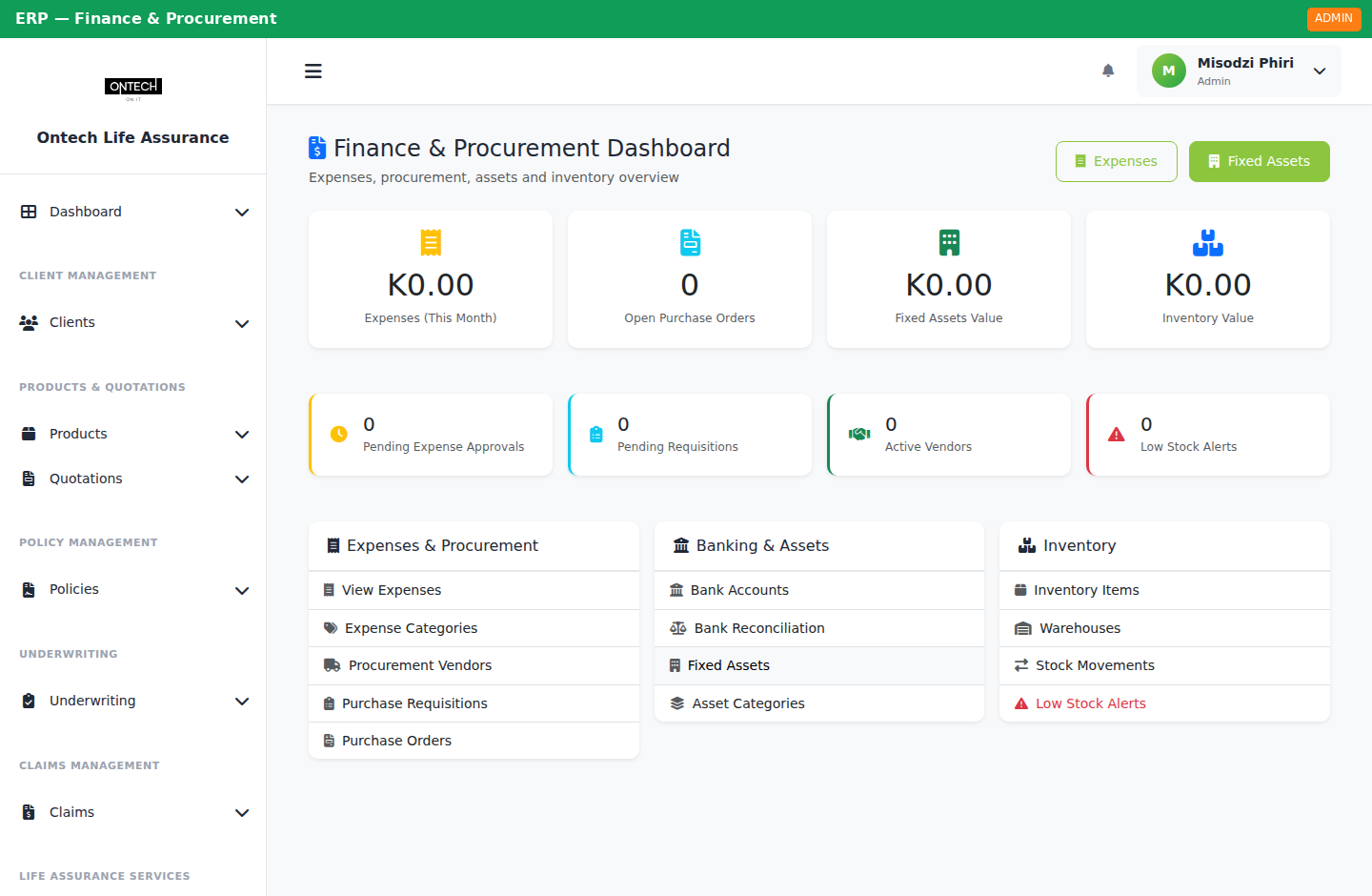
Ontech LifeI ERP includes a general ledger, bank reconciliation, expense management and actuarial and IFRS 17 reporting that read from the same policy, premium and claims records as operations.
Key capabilities
General ledger and chart of accounts
Maintain the chart of accounts, journals and period closes, with automatic postings from premiums, claims, commissions and payouts.
Premium receivables and collections
Track premiums due and received per policy, allocate Mobile Money and bank receipts, and report arrears.
Bank reconciliation
Match bank and Mobile Money statements to receipts and payments and clear exceptions.
Claims, commissions and payouts
Post claim settlements, surrender and maturity payouts and commission runs through maker-checker approval.
Actuarial reserves and statutory funds
Support reserve calculations, bonus and surplus allocation, statutory fund and solvency views for long-term business.
IFRS 17 reporting
Group contracts, track contractual service margin and produce the disclosures required under IFRS 17 from policy-level data.
Expenses, procurement and fixed assets
Record operating expenses, purchase orders and depreciation in the same ledger as insurance transactions.
How it works
- Premiums received through Mobile Money, bank or cash are allocated to policies and posted to premium income and receivables.
- Claims, surrenders, loans and commissions are approved through maker-checker workflows and posted to the ledger on approval.
- Bank and Mobile Money statements are reconciled against the receipts and payments recorded in the system.
- Reserves, bonuses and statutory fund movements are calculated from the in-force policy data.
- Period-end closes produce financial statements, IFRS 17 disclosures and the figures used in statutory returns.
Benefits
Ledger agrees with operations
Because postings come from the policy and claims records, premium income and claims expense reconcile to the registers.
Faster month-end
Automatic postings and reconciliation remove most of the manual journals finance teams build in spreadsheets.
IFRS 17 from real data
Contract grouping and disclosures use policy-level data rather than aggregated estimates.
Audit trail on every entry
Each posting traces back to the policy, claim or payment that caused it and the user who approved it.
Who it is for
- CFOs and finance teams at life insurers closing the books from spreadsheets and a generic accounting package.
- Insurers preparing IFRS 17 financial statements and statutory returns.
- Actuarial teams that need reserves, bonuses and statutory fund figures from live policy data.
Zambia-specific considerations
Zambian insurers report under IFRS, so IFRS 17 applies to their insurance contracts, and the Pensions and Insurance Authority (PIA) requires periodic statutory returns and audited financial statements. Producing both from one ledger that is fed by the policy system avoids the reconciliation gaps that arise when finance and operations use separate systems.
Premium receipts in Zambia arrive largely through MTN Mobile Money, Airtel Money and Zamtel Kwacha, often in small monthly amounts. Reconciling those receipts to policies and to the bank is a daily task that accounting software for this market needs to automate.
How Ontech LifeI ERP addresses this
One ledger for insurance and the company
Premiums, claims, commissions, payroll, procurement and fixed assets post to the same general ledger, so there is no second accounting system to reconcile.
IFRS 17 and actuarial built in
Life financial and actuarial modules cover reserves, bonus and surplus, statutory funds, solvency and IFRS 17 reporting.
Mobile Money reconciliation
Receipts from Mobile Money and bank channels are allocated to policies and reconciled to statements inside the platform.
Frequently asked questions
What is insurance accounting software?
Insurance accounting software is a general ledger and financial reporting system that also handles insurer-specific items such as premiums receivable per policy, claims reserves, commission liabilities, reinsurance balances and IFRS 17 measurement, ideally by posting them directly from the policy and claims systems.
Why can't an insurer use a generic accounting package?
It can keep a ledger, but it has no concept of policies, premiums due per policy, reserves or contract groups, so those figures must be calculated elsewhere and journaled in by hand, which is slow and hard to audit.
Does Ontech LifeI ERP support IFRS 17?
Yes. Ontech LifeI ERP includes IFRS 17 reporting alongside actuarial reserves, bonus and surplus allocation, statutory fund and solvency views, all calculated from policy-level data.
Can the accounting module reconcile Mobile Money receipts?
Yes. Mobile Money and bank receipts are allocated to the policies they pay for and reconciled against statements in the bank reconciliation module.
Does it include payroll and procurement?
Yes. HR and payroll, expenses, procurement, fixed assets and inventory are part of Ontech LifeI ERP and post to the same general ledger.
Sources
See Ontech LifeI ERP for your company
Book a demo with Ontech Solutions in Lusaka and see policy administration, claims, Mobile Money collection and PIA reporting working together in one platform.
Last updated 2026-09-13. Published by Ontech Solutions, Lusaka, Zambia.