Solutions by role
Insurance ERP for CFOs: general ledger, IFRS 17 and reconciliation
For a chief financial officer, an insurance ERP means the general ledger, premium receivables, claims payables, commissions and expenses are posted from the same transactions the operations team records, so the finance function stops re-keying policy data into an accounting package and reconciling the two. It also gives finance the contract-level data that IFRS 17 and regulatory returns require.
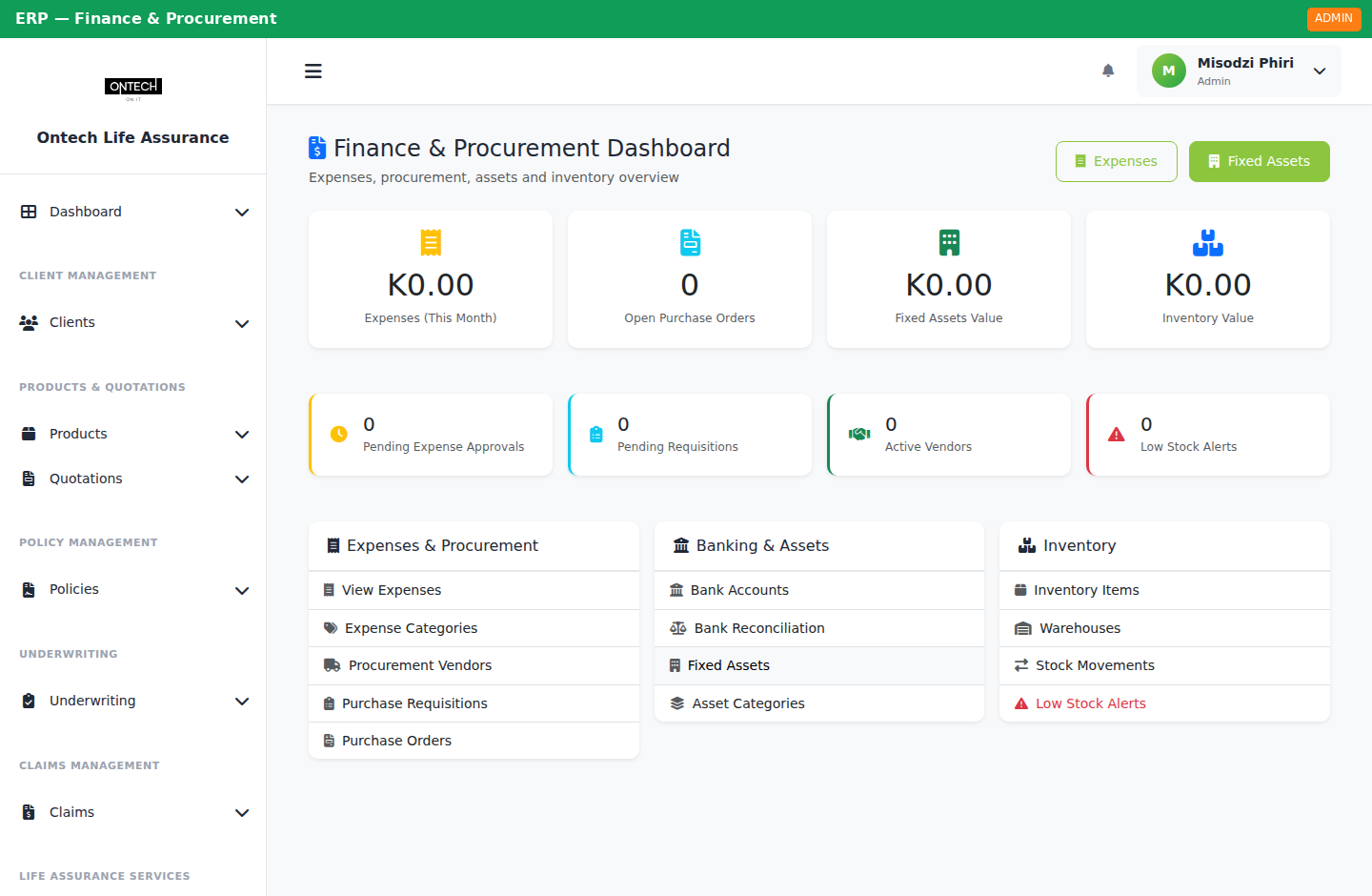
Ontech LifeI ERP gives CFOs of life insurers in Zambia an integrated general ledger, automated posting of premiums, claims and commissions, bank and Mobile Money reconciliation, actuarial and IFRS 17 reporting, and the financial schedules needed for Pensions and Insurance Authority returns and Zambia Revenue Authority filings.
Key capabilities
Integrated general ledger
Premiums, claims, commissions, reinsurance and expenses post automatically to a configurable chart of accounts with journal entries you can trace back to the policy or claim.
Premium receivables and collections
See what is billed, collected and overdue by policy, product and channel, with collection follow-up assigned to staff or agents.
Bank and Mobile Money reconciliation
Match bank statement lines and Mobile Money receipts from MTN, Airtel and Zamtel to premium and claim transactions, and clear exceptions.
IFRS 17 and actuarial reporting
Produce contract-level measurements, reserves and disclosures from the policy data, supported by the actuarial module.
Payables with maker-checker control
Claims, commissions, supplier invoices and payroll are paid through approval workflows in which the same person cannot create and approve a payment.
Expenses, procurement and fixed assets
Expense claims, purchase orders, supplier invoices, asset registers and depreciation run in the same ledger as the insurance business.
Regulatory and tax schedules
Financial statements, PIA return schedules and the figures needed for ZRA filings are generated from the ledger.
How it works
- The chart of accounts and posting rules are configured for each transaction type: premium, claim, commission, reinsurance, expense, payroll.
- Operational events post journals automatically as policies are issued, premiums received and claims settled.
- Bank and Mobile Money statements are imported and matched against those journals; unmatched items are worked as exceptions.
- Payables move through approval workflows with maker-checker separation before payment files are released.
- Period-end reports, IFRS 17 measurements and regulatory schedules are run from the closed ledger.
Benefits
No duplicate data entry
Finance does not re-enter policy or claim data; the ledger is fed by the operational system.
Faster, cleaner closes
Reconciliation is continuous rather than a month-end scramble, and exceptions are visible as they arise.
Contract-level data for IFRS 17
Because the ledger is linked to individual policies, the groupings and cash flows IFRS 17 needs are available without a separate data project.
Control over cash
Every payout is approved by someone other than its creator and is on the audit trail.
Who it is for
- CFOs and finance directors of licensed long-term insurers in Zambia.
- Finance teams currently maintaining a separate accounting package alongside a policy system.
- Insurers preparing IFRS 17 disclosures and PIA returns from spreadsheets.
Zambia-specific considerations
Zambian life insurers collect a growing share of premiums through MTN Mobile Money, Airtel Money and Zamtel Kwacha, which produces high volumes of small receipts. Reconciling those to individual policies is impractical by hand; it needs automatic matching in the same system that holds the policies.
IFRS 17 applies to insurance contracts for reporting periods beginning on or after 1 January 2023, and long-term insurers in Zambia also file periodic returns with the Pensions and Insurance Authority and tax returns with the Zambia Revenue Authority. Producing all three from one ledger avoids reconciling different versions of the same numbers.
How Ontech LifeI ERP addresses this
Finance is a core module, not an integration
Ontech LifeI ERP's general ledger, bank reconciliation, expenses, procurement and fixed assets are part of the platform and post from the insurance modules directly.
Actuarial, IFRS 17 and life financial modules
Reserves, bonus and surplus, statutory funds and solvency reporting are produced from the same policy records the business runs on.
Payments under maker-checker
Claims and other payouts follow a multi-level approval with separation of duties before release, and every approval is recorded.
Frequently asked questions
Does Ontech LifeI ERP include a general ledger?
Yes. It has an integrated general ledger with a configurable chart of accounts, automatic posting from premiums, claims, commissions and expenses, and bank reconciliation.
How does the platform support IFRS 17?
Policy-level data, cash flows and reserves are held in the system, and the IFRS 17 and actuarial modules produce contract measurements and disclosure figures from them rather than from a separate data extract.
Can it reconcile Mobile Money receipts?
Yes. Receipts from MTN Mobile Money, Airtel Money and Zamtel Kwacha are matched to the policy and premium they relate to, and the reconciliation module clears bank and Mobile Money statements against the ledger.
How are claim payments controlled?
Claim payouts pass through a multi-level approval workflow with maker-checker separation: the person who prepares a payment cannot approve it, and each step is logged.
Can finance reports be produced for the PIA and ZRA?
Financial statements and the schedules needed for Pensions and Insurance Authority returns and Zambia Revenue Authority filings are generated from the ledger and the life reports module.
Sources
See Ontech LifeI ERP for your company
Book a demo with Ontech Solutions in Lusaka and see policy administration, claims, Mobile Money collection and PIA reporting working together in one platform.
Last updated 2026-09-13. Published by Ontech Solutions, Lusaka, Zambia.